Where to Find Jobs in Web Development

Nobody likes job hunting. It is time‑consuming, nerve‑wracking and frustrating, even at the best of times. You have the expertise, you have the know‑how, and you need to pay the bills ‑ but your emails go unanswered, recruiters who at first seem keen and communicative go quiet and it's hard to get a foot in the door.
Thankfully for people considering a career switch into web development or for seasoned developers looking for a new role, the environment is changing. Remote work is now commonplace in a lot of companies, and organisations are looking further afield than they ever have before for talented and driven workers.
But, where is the best place to find work for web developers? Is it best to go to job boards, or apply directly via email? And what if you wanted to pick up a little bit of work on the side ‑ where do you go to find that? Let's take a look.
Salaried Positions
Let's start with the meatiest portion of this post; the full (or part)‑time positions as an employee of a company, rather than as a freelancer or contractor.
I find that there are a couple of places to find these roles, each with its own pros and cons.
Job Boards
First up, the most popular way to find web development work; job boards. Hop onto something like Indeed, Reed or Monster and enter your search terms. Use the filters to specify what you're looking for by way of salary, and location, all kinds of filtering options are available across these sites to narrow down your search.
Some of these job board sites will require you to upload a CV or build one through forms on the site ‑ I recommend, if you can, creating specific CVs for specific areas of web development (e.g., a "Front End developer" CV, or a "Full‑Stack developer" CV). These boards also tend to give you the option to create a cover letter for each application ‑ there's some debate about whether cover letters are important in this day and age ‑ but there's every chance it's worth filling out.
I wouldn't create a cover letter specifically for every posting unless there is something worth addressing in that role, but I would tailor it to the kind of work I'm applying for. Before uploading a CV, check the provider's privacy and recruiter‑visibility settings, and what an application shares with that employer. Uploading does not automatically mean every recruiter can see it. In my own searches, I've had as many as twenty calls in the first 24 hours after reactivating an account, often about unsuitable roles. That is my experience of those searches, not a guarantee of how every board behaves.
Here are some job boards that might be helpful for you:
Job Boards are for Contracts Too
Don't forget: if you're a contractor, job boards are a great place to find less‑permanent (but probably still full‑time) roles too.
Aggregators: Not All Job Boards are Equal
From personal experience, some job boards are better than others. If you're in a time‑pressured hunt for a role then by all means, create accounts and comb listings to apply on each individual website.
For a more casual search, I tend to start with Indeed or Jooble. They gather listings from several sources, which helps me cover more ground in one place. That does not tell us how another board ranks its results, or mean that every suitable vacancy will appear in an aggregator. It is still worth checking the employer's own careers page.
This does mean you'll often find duplicates where the same role has been advertised in more than one place, although they are doing a lot of work to reduce that.
The most useful feature, though, is their job alerts. Once you've searched for a role, keep an eye out for the job alerts dialogue (usually it's in the right‑hand column, but they have been known to restructure their listing page in the past).
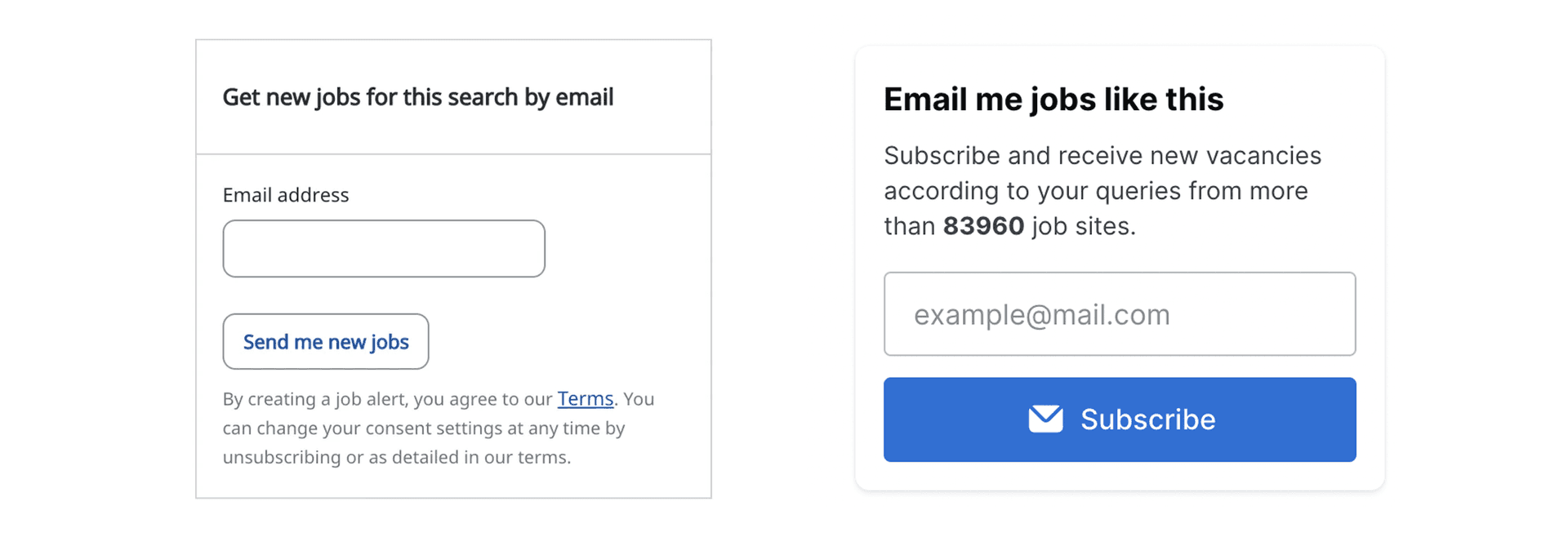
This is how I tend to start a search for a new role. Set up an alert for the work you want, then check its relevance and delivery frequency. An early application can help when employers review candidates as they arrive, but it does not replace the qualifications or evidence the role requires.
For what it is worth: both Jooble and Indeed appear to function very similarly. I tend to find that Jooble just has the slight edge simply because their job categorisation and filtering is a little more robust: when receiving job alerts, Indeed can often still send roles that aren't quite right whilst my experience from Jooble is that they tend to do a better job of matching search results with job opportunities.
Social Networking
Next up, social sites. These can offer you a chance to cut past recruiters and speak directly to people in‑house, getting yourself onto the desk of a decision‑maker and getting a better chance of advancing in the application process ‑ but they do also require you to put a little more effort into your application.
Stick around to the end of this section for a sneaky little hack that I've used to apply to jobs in the past, with some success.
You can find jobs posted by companies on sites like:
Generally, you are probably best off using LinkedIn for this, unless you've got your eyes on a specific company. As you probably already know, LinkedIn has a jobs section which allows you to filter and browse available vacancies. LinkedIn also allows you to set your profile as "Open to Work" or "Looking for Work", which will get all of the recruiters nationwide cramming themselves into your inbox. It's sometimes useful, but you'll definitely have to wade through completely irrelevant jobs to find something worth your while here.
So, what's the hack I mentioned earlier? Well, with LinkedIn, you can search for a company and then find people who work at that company. If you apply for a job via a listing, you go into the long list of applications for that role. It's hard to get noticed that way.
If you apply, and then follow up by searching for decision‑makers at the company (e.g., the Head of the Department you're applying for), it is much easier to get in touch directly and make an impression. You can even, as I have previously, look for directors through Companies House, then use that information to reach out on LinkedIn and message them directly. It's a bit risky; you definitely don't want to harass or personally annoy somebody who is in charge of hiring, but it's a good way to get on their radar at the same time.
Cold Outreach
Finally, you can of course try reaching out via email directly. This works best if you've seen that the company is hiring already, and it's not dissimilar to reaching out directly through LinkedIn. Hit up their website, and try to find an email other than hello@... or info@.... If you can, see if you can track down a department‑specific email address, or ‑ even better ‑ the email address of the hiring manager.
Cold emailing is the method that requires the most effort. You've got to craft a specific email for that role, and you'll want to tailor your CV as well. You'll have to put in some work to find an effective email address to reach out to, and you'll need to make sure you're not wasting the opportunity; you need to nail it on the first try with this because there are no second opportunities when you're potentially just bothering somebody.
To offer a personal story: back in 2010 I worked for McCann Manchester in their Metro office in the city centre (which sadly got closed down). Whilst standing outside the front of the office one afternoon, I was approached by a guy clutching a leather pouch of work; he was a recent design graduate walking from one agency in the city centre to the next, looking for work.
By all accounts, he had been having a pretty miserable day: most places had not even spoken with him, and the traditional Manchester weather was certainly also taking a toll. I was able to introduce him to our creative director, who was impressed with his work. A week later, he was interviewed, hired, and stayed for five years, progressing from junior to senior.
So, even attempting to cold call in person can pay off if you are determined and persistent enough.
Freelance Work
When it comes to moonlighting, you've got plenty of choices. Cold emails and cold outreach (including phone calls) work just fine ‑ but again, it's a lot of effort. You've got to run your own marketing, which is a pain when you're also actually doing the work you land for the clients that are interested.
The alternative is to head to the platforms that are specifically built for this kind of work. There's an ocean of terrible‑paying, rude and difficult clients on these platforms ‑ but there are sometimes diamonds in the rough. If you're looking for job boards for freelance web developers, here are some choices:
The Wrap‑up
Ultimately, applying for work is a numbers game. You're going to want to apply to plenty of positions because there are a lot of other people also applying for those jobs. You need to decide how much effort you want to put in. I've always found that a mixture of the methods is the best way to go; applying to a lot of jobs via job boards, but reaching out directly to companies and hiring managers when there's an opportunity I'm really passionate about.
Good luck, and happy hunting!
Postscript
July 2025: BOLD acquired the CareerBuilder and Monster job‑board businesses. The names and comparisons above come from my 2022 searches, so check each provider's current service before making it part of your routine.
September 2026: Indeed's current privacy guidance distinguishes a searchable profile from one employers cannot find. Applying for a role still shares information with that employer. Check the actual setting in your account rather than assuming that uploading a CV makes it public.