Solving the LeetCode N‑Queens Problem

The N‑Queens puzzle challenges you to place N chess queens on an NxN grid without any queen threatening another (in chess, a queen can attack any piece located on the same row, column, or diagonal). This problem isn't just a mental exercise; it offers a deep exploration into algorithmic logic and backtracking techniques, which I've previously covered in my problem‑solving articles.
As with any of these problems, the actual language or tech stack you use matters less than your understanding of how the algorithm works and how it can be deployed. So ‑ as always ‑ I'm going to revert to solving this in the front end, using TypeScript...
Problem Statement
Place N chess queens on an N×N chessboard so that no two queens threaten one another.
Each board configuration should be represented as a list of strings, where each string represents a row and a Q represents the placement of a queen on that row.
For Example:
Input: N = 4
Output: [['.Q..', '...Q', 'Q...', '..Q.'], ['..Q.', 'Q...', '...Q', '.Q..']]
There are only two ways a 4‑by‑4 chess board with four queens on it can be configured without the queens threatening one another:
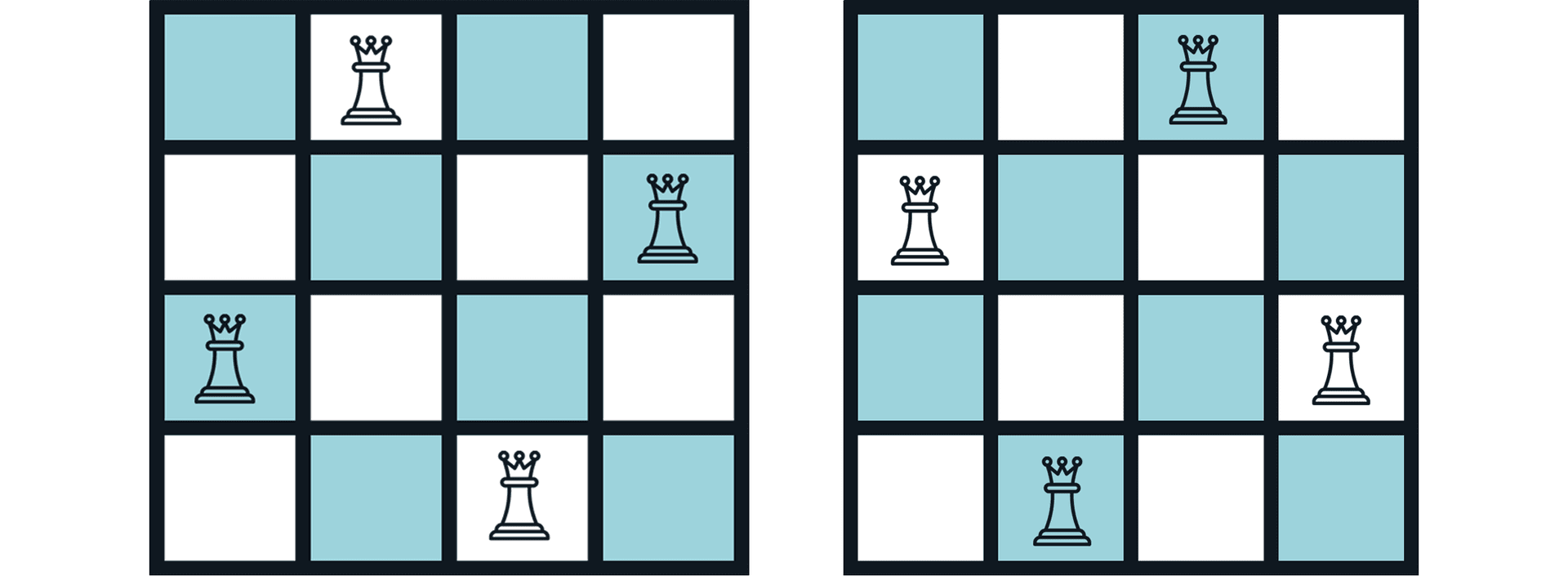
Input: N = 1
Output: [['Q']]
If there's only one queen, and the board is only a single cell, then there's only one configuration possible:

Solving Using Backtracking and TypeScript
This is a classic example of a problem that can be solved using a backtracking technique. In this, we solve the problem recursively by building a sequence of choices.
The essence of backtracking is a bit of a try‑it‑and‑see approach where we choose an option at each decision point in a systematic way. If a choice leads to a solution, we take it; otherwise, we backtrack and try the next option. In this case, the "choices" are the positions that we can place queens on the board, and the "solution" is a board where no two queens threaten each other.
So, using the backtracking algorithm, we can explore all possible board configurations and, thus, find the solutions.
In Code
Here's what that looks like using TypeScript:
const solveNQueens = (n: number): string[][] => {
  const board: string[][] = Array.from({ length: n }, () => Array(n).fill('.'));
  const results: string[][] = [];

  const isSafe = (row: number, col: number) => {
    for (let i = 0; i < row; i++) {
      for (let j = 0; j < n; j++) {
        if (
          board[i][j] === 'Q' &&
          (j === col || i + j === row + col || i - j === row - col)
        ) {
          return false;
        }
      }
    }
    return true;
  };

  const backtrack = (row: number) => {
    if (row === n) {
      results.push(board.map((row) => row.join('')));
      return;
    }

    for (let col = 0; col < n; col++) {
      if (isSafe(row, col)) {
        board[row][col] = 'Q';
        backtrack(row + 1);
        board[row][col] = '.';
      }
    }
  };

  backtrack(0);
  return results;
};
How It Works
Initialisation:
Theboardis initialised as ann x nmatrix filled with dots, representing empty cells. Theresultsarray will hold our solutions.Safety Check:
TheisSafefunction checks if placing a queen in a particular cell is safe, that is, it doesn't threaten any other queens already placed on the board.Backtracking Function:
Thebacktrackfunction is the core of the algorithm. It tries to place a queen in each row, starting from the top. If placing the queen is safe, it makes the placement and moves on to the next row.Solution Found:
Whenbacktrackreaches a row number equal ton, it means a solution is found. The current board configuration is converted to the required string format and added toresults.Backtrack:
If placing a queen in a row is not possible without threatening another queen, the algorithm backtracks, changing the previous rows' queen positions.
The Backtracking Tree
The useful way to picture N‑Queens is as a decision tree. Each row asks one question: which column can safely hold a queen? If a placement makes the board invalid, that branch stops immediately and the algorithm returns to the previous row.
That early stopping is the point of backtracking. We are still exploring possible boards, but we avoid spending time on branches that already break the row, column or diagonal rules.
Complexity and Tests
The search space grows quickly because each row creates several possible choices. Backtracking cuts that down, but this is still an exponential problem in the general case. The exact runtime depends on how quickly invalid branches are rejected.
Test n = 1, a small impossible board such as n = 2 or n = 3, and a known valid size such as n = 4. Those cases prove both the success path and the backtracking failure path.
Wrapping Up
And there you have it! The key to solving problems like this is in understanding how to navigate the choice tree effectively, knowing when to proceed and when to backtrack.